How to Detect AI Writing?
Posted on January 27, 2026 by The AICheckerFree Team
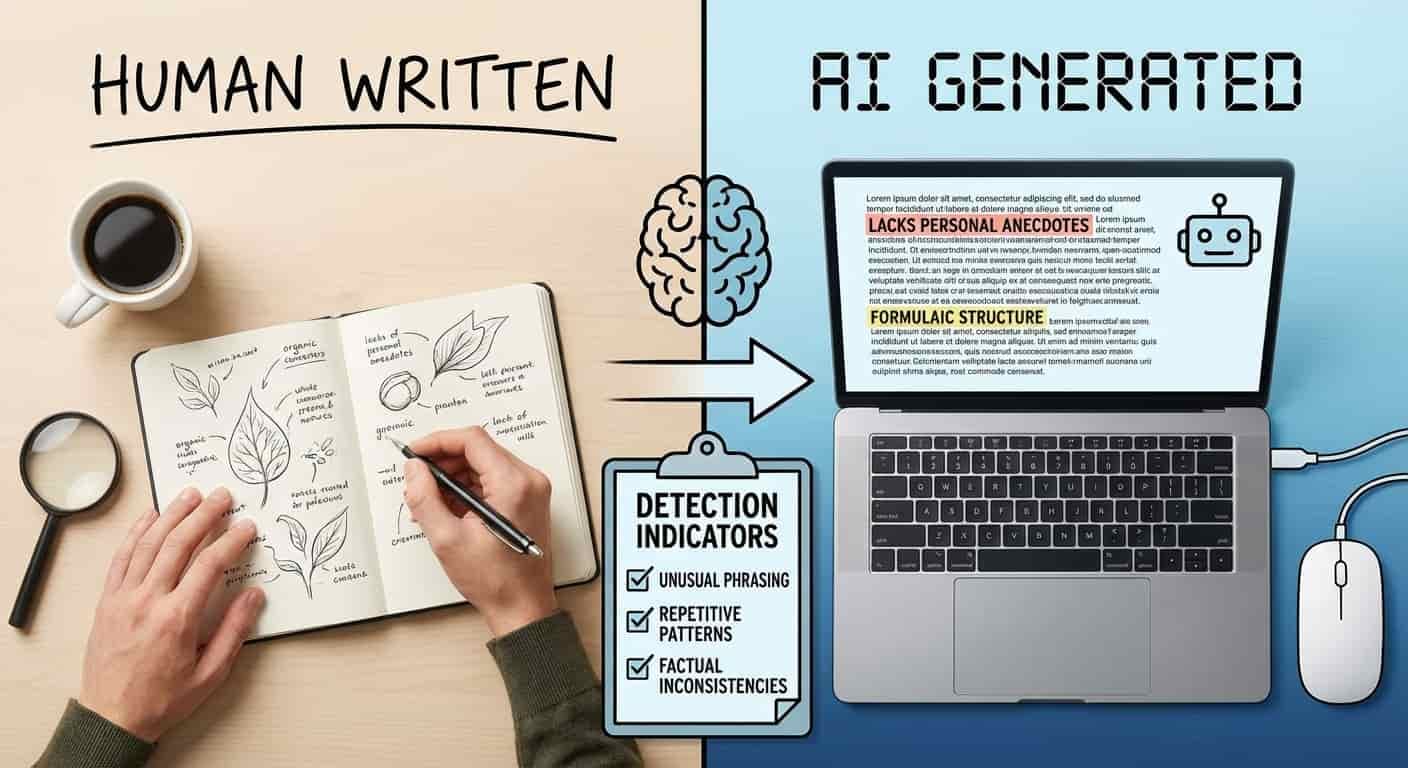
In an era where artificial intelligence can produce human-like text in seconds, the ability to distinguish between human and AI-generated content has become a crucial skill. Whether you're an educator ensuring academic integrity, a content manager maintaining brand voice, or simply a curious reader, knowing the signs of AI writing is essential. This guide will walk you through the key indicators.
1. Unnatural Consistency and Perfection
Human writing has a natural rhythm and flow, complete with occasional errors, stylistic quirks, and variations in tone. AI-generated content, on the other hand, often exhibits a level of perfection that can be a dead giveaway.
- Perfect Grammar and Syntax: While humans often make minor grammatical mistakes, AI models are trained on vast datasets and typically produce text with flawless grammar.
- Uniform Sentence Length: AI-generated text may have very consistent sentence lengths and structures, whereas humans tend to vary their sentence patterns for better readability.
- Consistent Tone: The tone in AI writing often remains unnaturally consistent throughout the entire piece, lacking the subtle emotional shifts common in human expression.
2. Lack of Personal Voice and Anecdotes
Human writers infuse their work with personality, personal experiences, and unique perspectives. AI struggles to replicate this.
- Generic Phrasing: AI often relies on common phrases, clichés, and generic statements because it draws from a broad-based statistical understanding of language.
- Absence of Personal Stories: AI cannot have real-life experiences, so it cannot share genuine anecdotes or personal reflections. Any stories it tells are fabricated and often lack authentic detail.
- Vague and Abstract Language: The content might feel detached, overly formal, or too general, lacking the specific, concrete details that come from real-world experience.
3. Repetitive Patterns and Predictable Structure
Language models work by predicting the next most likely word, which can lead to predictable and repetitive text.
- Overused Keywords: An AI might repeat certain keywords or phrases unnaturally to stay on topic.
- Formulaic Structure: AI-generated articles often follow a very standard structure (Introduction, Point 1, Point 2, Point 3, Conclusion) without creative deviation.
4. How AI Detection Tools Can Help
While these manual checks are useful, the most reliable way to detect AI writing is to use a specialized tool like AICheckerFree. Our tool analyzes text using advanced algorithms that measure linguistic characteristics that humans can't easily spot, such as:
- Perplexity: A measure of how surprised a language model is by a sequence of words. Human writing tends to have higher perplexity.
- Burstiness: The variation in sentence structure and length. Human writing is naturally more 'bursty' than the uniform text produced by AI.
By combining these technical metrics with pattern recognition, AICheckerFree provides a highly accurate probability score, giving you the confidence you need to assess the authenticity of any text.